These AI summaries appear above traditional search results and give users quick answers without opening multiple websites.
This change has created a new challenge for website owners, bloggers, SEO experts, and businesses.
Now the goal is not only to rank.
The real goal is to become a trusted source that Google’s AI systems choose, understand, and cite.
That is why many websites with strong rankings still fail to appear in AI Overviews, while some smaller websites get featured even without ranking #1.
In this guide, you will learn exactly how to improve your chances of appearing in Google AI Overviews using modern SEO strategies, semantic optimization, topical authority, and AI-friendly content structures.
What Are Google AI Overviews and How Do They Work?
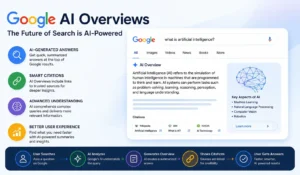
Google AI Overviews are AI-generated summaries shown at the top of search results. These summaries are created using Google’s Gemini AI models and information gathered from different websites across the web.
Instead of showing only blue links, Google now tries to answer the user’s question directly.
For example, if someone searches:
“How to rank in Google AI Overviews”
Google may generate a summary explaining:
- ranking factors
- SEO techniques
- content structure
- optimization tips
- trusted sources
The websites used in these summaries often gain more visibility, authority, and trust.
That is why businesses are now focusing on how to rank in ai overviews and improve their visibility in AI-generated search results.
How Google Generates AI Overviews
Google’s AI systems do much more than traditional keyword matching.
The system analyzes:
- search intent
- context
- semantic relevance
- topical authority
- entity relationships
- content quality
- EEAT signals
- user satisfaction
Google also uses something called query fan-out.
This means Google expands one search into multiple related searches to build a better answer.
For example, if a user searches:
“How to optimize for AI Overviews”
Google may also analyze related questions like:
- what are AI Overviews
- AI Overview ranking factors
- SEO for AI search
- semantic SEO techniques
- AI search optimization
- topical authority strategies
This is why websites with broader topic coverage often perform better in AI-generated search.
Understanding Query Fan-Out and AI Retrieval
One of the biggest changes in modern search is retrieval-based SEO.
Traditional SEO focused heavily on rankings.
AI search focuses more on retrieval.
Google’s AI systems search for:
- the most relevant passages
- the clearest explanations
- trustworthy information
- semantically rich content
- retrievable answers
This is where ai overview optimization becomes important.
Instead of only optimizing pages for keywords, you must optimize content for:
- contextual relevance
- semantic depth
- retrievability
- quotability
If your content clearly explains a topic in simple language, Google’s AI systems can easily extract and summarize it.
That improves your chances of appearing in AI-generated answers.
How Google Chooses Sources and Citations
Many people believe only top-ranking websites appear in AI Overviews.
That is not always true.
Google may select a source because:
- the answer is clearer
- the content is easier to retrieve
- the topic coverage is stronger
- the passage directly satisfies user intent
- the content demonstrates expertise
This explains why some smaller websites appear inside AI Overviews even without ranking at the top of traditional search results.
Google’s AI systems prefer content that:
- answers questions quickly
- uses scannable formatting
- explains topics clearly
- covers related entities naturally
- demonstrates authority
This is why ai search optimization is becoming different from traditional SEO.
Can Websites Rank in AI Overviews Without Ranking #1?
Yes.
Many websites appear in AI Overviews without holding the first organic position.
This happens because AI retrieval systems evaluate more than rankings.
Google also considers:
- contextual relevance
- semantic matching
- information completeness
- content structure
- retrievability
- topic authority
This is one reason why ranking in ai overviews is different from ranking in traditional search.
A page with:
- better answers
- clearer structure
- stronger semantic coverage
- stronger EEAT
can sometimes outperform higher-ranking pages inside AI-generated results.
The Core Ranking Factors Behind Google AI Overviews
Google has not publicly revealed every AI Overview ranking signal.
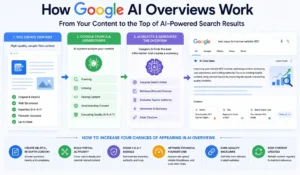
But after analyzing competitors, official Google documentation, and real AI Overview behavior, several important ranking factors are becoming clear.
Semantic Relevance and Search Intent
One of the strongest ranking signals is semantic relevance.
Google now understands relationships between:
- topics
- entities
- user questions
- context
- search intent
This means your article should not only repeat one keyword.
Instead, your content should naturally cover:
- related topics
- supporting entities
- connected concepts
- common user questions
For example, a page targeting how to rank in google ai overviews should also naturally discuss:
- AI search
- semantic SEO
- topical authority
- structured data
- AI retrieval systems
- search intent
- query fan-out
- AI citations
This creates stronger semantic depth.
Topical Authority and Entity SEO
Google trusts websites that consistently publish helpful content around one topic.
This is called topical authority.
For example, if your website regularly publishes articles about:
- SEO
- AI search
- semantic SEO
- AI Overview ranking
- search optimization
Google begins to associate your brand with those topics.
This improves your authority signals.
Entity SEO is also becoming more important.
Google’s systems now understand entities such as:
- brands
- people
- products
- technologies
- topics
Strong entity relationships improve contextual trust.
That is why websites focusing on seo for ai overviews should build content clusters instead of publishing random articles.
Why EEAT Matters for AI Search
EEAT stands for:
- Experience
- Expertise
- Authoritativeness
- Trustworthiness
Google heavily relies on EEAT for AI-generated search results.
Because AI Overviews summarize information directly, Google wants trustworthy sources.
You can improve EEAT by:
- showing real expertise
- adding author information
- publishing original insights
- using accurate information
- improving website trust
- citing reputable sources
- sharing real experiences
For example, brands like Meta Achievers can improve trust by consistently publishing helpful and experience-driven content instead of generic AI-written articles.
Google wants signals that show:
“This content was created by someone who understands the topic.”
Passage Indexing and Contextual Relevance
Modern search systems often retrieve individual passages instead of entire pages.
This means:
a single paragraph from your article can appear inside an AI Overview.
That is why every section of your content should:
- answer a clear question
- stay contextually focused
- provide direct value
- avoid filler text
This is also why optimize content for google ai overviews is becoming a major SEO topic.
Your article should contain:
- concise answers
- clear explanations
- semantically connected sections
- easy-to-understand formatting
When Google scans your page, it should easily identify:
- what each section is about
- which problem it solves
- why it is valuable
Brand Mentions and Citation Trust
Backlinks still matter.
But AI search also looks at brand mentions across the web.
Google may trust brands that are:
- frequently mentioned
- consistently referenced
- associated with expertise
This includes mentions on:
- YouTube
- blogs
- forums
- news sites
That is why google ai overviews optimization now goes beyond traditional backlinks.
A strong online presence helps build citation trust.
Why Generic Content Fails in AI Overviews
One of the biggest mistakes website owners make is creating generic content.
Many AI-written articles repeat the same advice:
- create quality content
- improve SEO
- build backlinks
But Google’s AI systems increasingly prefer information gain.
Information gain means:
your content should add something useful, unique, or better than existing pages.
If your article says the same thing as everyone else, Google has no reason to cite it.
That is why modern ai search engine optimization requires:
- original insights
- practical frameworks
- better explanations
- deeper topic coverage
- real examples
The goal is not just to publish content.
The goal is to publish content worth retrieving.
How to Structure Content for AI Overviews
Content structure is now one of the most important parts of AI SEO.
Google’s AI systems prefer content that is:
- easy to scan
- easy to understand
- easy to retrieve
- easy to summarize
A well-structured article improves both:
- user experience
- AI readability
Use Answer-First Formatting
One common pattern in AI Overview citations is answer-first formatting.
This means:
you answer the question immediately before expanding the explanation.
Example:
Question:
How do Google AI Overviews work?
Good answer:
Google AI Overviews are AI-generated summaries that combine information from multiple trusted sources to answer user queries directly in search results.
After that, you can explain the topic in detail.
This structure helps:
- users
- search engines
- AI retrieval systems
understand your content faster.
Create Scannable and AI-Readable Content
Most users scan content before reading it fully.
Google’s AI systems also prefer content with clear structure.
To improve readability:
- use short paragraphs
- add subheadings
- break down complex ideas
- use bullet points where needed
- avoid huge text blocks
This improves:
- engagement
- retention
- comprehension
- retrieval probability
Scannable content is especially important for optimize for ai overviews strategies.
Optimize Headings for Conversational Queries
Search behavior is changing.
People now search using conversational questions like:
- How can I rank in AI Overviews?
- Why does Google cite some websites?
- How does AI search work?
Your headings should reflect real search behavior.
This improves:
- semantic matching
- conversational relevance
- long-tail keyword visibility
Using conversational headings naturally supports ai search seo and modern search intent optimization.
Use Semantic Keyword Clustering Naturally
Modern SEO is no longer about repeating one keyword many times.
Instead, Google wants natural semantic relationships.
For example, an article about how to optimize for ai search should naturally mention:
- AI search visibility
- semantic SEO
- entity optimization
- AI retrieval
- topical authority
- structured data
- AI-generated results
These related terms help Google understand:
- topic depth
- contextual relationships
- semantic relevance
Stuffing keywords unnaturally can actually reduce content quality.
Add Statistics, Examples, and Supporting Data
Supporting data improves trust and authority.
Google’s systems often prefer content backed by:
- examples
- statistics
- research
- expert opinions
- real-world observations
Even simple examples improve comprehension.
For example:
Instead of saying:
“Good structure helps SEO.”
Explain:
“Pages with clear headings, concise answers, and scannable formatting are easier for AI systems to retrieve and summarize.”
This creates stronger information value.
How to Make Content More Retrievable and Quotable
One of the biggest AI SEO opportunities is creating quotable content.
Google’s AI systems prefer:
- concise explanations
- clear definitions
- strong contextual paragraphs
- direct answers
To improve retrievability:
- answer questions directly
- avoid fluff
- simplify explanations
- organize information logically
- keep sections contextually focused
This improves your chances of appearing in:
- AI Overviews
- featured snippets
- AI-generated summaries
- conversational search results
Modern artificial intelligence search engine optimization is increasingly about becoming the best source for retrieval, not just rankings.
How to Optimize Content for Google AI Overviews
Creating content for AI search is very different from old-school SEO.
In the past, many websites ranked by:
- repeating keywords
- building links aggressively
- publishing short articles
Today, Google’s AI systems are smarter.
They evaluate:
- usefulness
- clarity
- semantic relevance
- contextual depth
- user satisfaction
- retrievability
That is why how to show up in ai overviews seo is becoming one of the biggest topics in modern search.
Target Informational and Long-Tail Keywords
AI Overviews appear mostly for informational searches.
These searches are usually:
- question-based
- conversational
- problem-solving focused
Examples include:
- how to rank in AI Overviews
- how to optimize for AI search
- how Google AI Overviews work
- how to improve visibility in AI Overviews
Long-tail keywords are important because they help Google understand detailed user intent.
Instead of targeting only broad keywords, create content around:
- real user questions
- detailed search phrases
- conversational searches
This improves your visibility for AI overview ranking and AI-generated search results.
Optimize for Query Fan-Out Searches
Query fan-out is one of the most important concepts in AI search.
Google expands a single query into multiple related searches to build a better answer.
For example, a search about:
“AI Overview optimization”
may also trigger related searches like:
- semantic SEO
- AI citations
- topical authority
- AI search optimization
- entity SEO
- structured data
- conversational search
This means your article should not stay too narrow.
You should cover:
- supporting subtopics
- related entities
- connected user questions
- contextual information
This improves your visibility for strategies to appear in google ai overviews and semantic retrieval systems.
Build Comprehensive Topic Clusters
Google trusts websites that deeply cover a topic.
Instead of publishing random articles, build content clusters.
For example:
Main Topic:
- Google AI Overviews
Supporting Articles:
- AI search optimization
- semantic SEO
- query fan-out
- entity SEO
- topical authority
- structured data
- AI Overview ranking factors
This creates stronger authority signals.
Topic clusters also improve:
- internal linking
- contextual relevance
- crawlability
- semantic relationships
Many websites ranking for AI search engine optimization already use this strategy successfully.
Focus on Information Gain Instead of Content Length
Many people believe longer content automatically ranks better.
That is not true anymore.
Google’s AI systems care more about information value than word count.
If your article simply repeats existing content, it may struggle to appear in AI Overviews.
This is why ai overview optimization now depends heavily on information gain.
You should:
- explain topics better
- add unique observations
- simplify difficult concepts
- share practical insights
- provide clearer frameworks
For example:
Generic advice:
“Create quality content.”
Better advice:
“Use answer-first formatting and semantic chunking so Google’s AI systems can easily retrieve your content.”
The second example adds more value and clarity.
Optimize for Featured Snippets and People Also Ask
AI Overviews often appear with:
- Featured Snippets
- People Also Ask
- Videos
- Images
This means optimizing for SERP features can also improve AI visibility.
To improve your chances:
- answer questions directly
- use concise explanations
- add numbered lists
- use bullet points
- create FAQ sections
- use question-based headings
Pages optimized for snippets are often easier for AI systems to retrieve.
This supports both:
- optimize for ai overviews
- ai searchability
Use Structured Summaries and Takeaway Sections
Google’s AI systems prefer summarized information.
Adding short takeaway sections helps:
- users understand faster
- AI systems retrieve key points
- search engines identify important ideas
Good summary sections usually include:
- key insights
- short explanations
- practical takeaways
This improves your chances of appearing in:
- AI Overviews
- snippets
- quick-answer results
Technical SEO for AI Overview Rankings
Technical SEO still matters a lot.
Even great content may fail if Google cannot properly:
- crawl
- index
- understand
- access
your pages.
That is why strong technical SEO supports seo for ai overviews and modern AI search visibility.
Improve Crawlability and Indexing
Google must first discover your pages before they can appear in AI results.
Common issues that hurt visibility include:
- broken pages
- blocked resources
- poor site structure
- indexing errors
- orphan pages
To improve crawlability:
- submit XML sitemaps
- fix broken links
- improve navigation
- keep URLs clean
- avoid duplicate pages
Simple site structures are easier for search engines and AI systems to understand.
Optimize Core Web Vitals and Mobile UX
Google wants users to have a good experience.
Slow websites often struggle in both:
- traditional search
- AI-generated search
Important Core Web Vitals include:
- Largest Contentful Paint (LCP)
- Interaction to Next Paint (INP)
- Cumulative Layout Shift (CLS)
You should also:
- compress images
- improve hosting
- reduce unnecessary scripts
- optimize mobile responsiveness
Fast websites improve:
- engagement
- trust
- retention
- user satisfaction
These are important for google ai search optimization.
Use Structured Data and Schema Markup
Schema markup helps Google better understand your content.
Structured data provides machine-readable information about:
- articles
- FAQs
- products
- authors
- organizations
Useful schema types include:
- Article schema
- FAQ schema
- HowTo schema
- Breadcrumb schema
- Organization schema
Structured data supports:
- semantic understanding
- contextual clarity
- AI retrieval
This is why optimize website for ai overviews often includes schema optimization.
Improve Internal Linking and Site Architecture
Internal links help Google understand relationships between pages.
They also improve:
- topical authority
- semantic connections
- crawl efficiency
- user navigation
Good internal linking strategies include:
- linking related articles
- using descriptive anchor text
- building topic clusters
- connecting supporting content naturally
For example:
an article about semantic SEO should naturally link to:
- AI Overview optimization
- entity SEO
- topical authority
- AI search visibility
This creates stronger semantic ecosystems.
Make Content Accessible for AI Crawlers
AI systems need clean and accessible content.
Avoid:
- cluttered pages
- excessive popups
- hidden content
- confusing layouts
Instead:
- keep design simple
- use readable fonts
- organize sections clearly
- prioritize readability
Some websites also experiment with LLMS.txt files.
While their impact is still debated, clean accessibility remains important for AI search optimization and AI retrieval systems.
How to Build Authority for AI Search
Authority is becoming one of the strongest ranking factors in AI search.
Google wants trustworthy sources for AI-generated answers.
This means your website should build:
- expertise
- credibility
- recognition
- trust
Build Topical Authority in Your Niche
Topical authority comes from publishing consistent, high-quality content around one topic.
For example, if your website regularly publishes:
- AI SEO
- semantic SEO
- AI Overview optimization
- entity SEO
- search visibility
Google starts associating your brand with those subjects.
This improves your visibility for:
- ai search seo
- google ai overviews optimization
- AI-generated search answers
Earn Backlinks and Brand Mentions
Backlinks still matter because they signal trust.
But AI systems also evaluate:
- brand mentions
- online reputation
- authority signals
Mentions from trusted websites improve:
- citation trust
- semantic confidence
- authority perception
Focus on:
- digital PR
- guest posting
- expert interviews
- useful tools
- original research
Natural mentions across the web improve your AI search visibility.
Increase Visibility Through YouTube, Reddit, and LinkedIn
Modern AI systems learn from multiple platforms.
Google’s AI retrieval systems often analyze:
- discussions
- videos
- expert opinions
- social mentions
Platforms like:
- YouTube
can strengthen your authority signals.
This is one reason why many brands investing in AI in search visibility are expanding beyond traditional blogs.
Create Expert-Driven and Trustworthy Content
Trust is critical for AI-generated search.
To improve trust:
- use real examples
- avoid fake claims
- explain concepts clearly
- provide accurate information
- update outdated content
Content written from real understanding performs better than generic AI-generated articles.
That is why strong EEAT remains important for how to optimize for ai search and AI-driven search visibility.
Common Mistakes Preventing AI Overview Rankings
Many websites fail in AI search because they still follow outdated SEO habits.
Avoiding these mistakes can significantly improve your chances of appearing in AI Overviews.
Publishing Generic AI-Generated Content
One of the biggest problems online today is repetitive AI-written content.
Many articles:
- copy competitors
- repeat the same advice
- add no original value
Google increasingly prefers:
- unique insights
- helpful explanations
- information gain
- expert perspectives
If your article sounds like every other article, it becomes harder for AI systems to trust or retrieve it.
Ignoring Search Intent
Some websites focus too much on keywords and forget the user.
If someone searches:
“How to rank in AI Overviews”
they expect:
- practical advice
- clear explanations
- actionable strategies
not unrelated information.
Matching search intent improves:
- relevance
- engagement
- retrieval probability
Weak Semantic Coverage
Many pages target one keyword but fail to cover related concepts.
Strong semantic coverage means discussing:
- supporting topics
- connected entities
- related user questions
- contextual ideas
This improves Google’s understanding of your content.
Poor User Experience and Page Speed
Slow pages frustrate users.
Bad UX can reduce:
- engagement
- trust
- satisfaction
Keep your pages:
- fast
- clean
- readable
- mobile-friendly
Good UX supports both SEO and AI retrieval systems.
Over-Optimizing Keywords Unnaturally
Keyword stuffing is outdated.
Instead of repeating the same keyword unnaturally, focus on:
- natural language
- semantic relevance
- contextual clarity
This creates better content for:
- users
- search engines
- AI systems
Modern ai search engine optimization techniques depend more on context than repetition.
How to Track AI Overview Visibility
Tracking AI visibility is becoming an important part of modern SEO.
In the past, businesses mainly tracked:
- keyword rankings
- backlinks
- organic traffic
Now, websites also need to monitor:
- AI citations
- AI Overview appearances
- brand mentions
- AI-generated visibility
This is important because many users now interact with AI-generated search answers before clicking any website.
That is why how to track ai overviews rankings is becoming a growing SEO topic.
How to Check If Your Content Appears in AI Overviews
The easiest method is manual searching.
Search your target keywords in Google and check:
- whether an AI Overview appears
- which websites are cited
- what type of content Google retrieves
- how the answers are structured
Pay attention to:
- paragraph structure
- formatting
- summaries
- headings
- citations
- answer style
This helps you understand what Google prefers for ranking in ai overviews.
You should also compare:
- your content
- competitor content
- AI Overview citations
to identify content gaps.
Tools for Tracking AI Citations and Visibility
Several SEO tools now track AI Overview visibility.
Popular options include:
These tools can help you monitor:
- AI citations
- keyword triggers
- SERP features
- AI Overview appearances
- visibility trends
You can also use:
- Google Search Console
- GA4
- Looker Studio
to monitor traffic patterns and engagement signals.
Many brands focusing on google ai overviews optimization are now adding AI visibility tracking to their SEO workflows.
Important AI SEO Metrics to Monitor
Traditional SEO metrics still matter.
But AI search introduces new visibility signals.
Important metrics include:
- AI Overview appearances
- brand mentions
- engagement time
- scroll depth
- topical authority growth
- semantic visibility
- branded searches
- returning visitors
Instead of focusing only on clicks, businesses should also monitor:
- trust
- visibility
- brand exposure
- AI citations
This is important because AI search often creates more zero-click searches.
Even if users do not click immediately, your brand visibility can still increase significantly.
Future of SEO in the AI Search Era
SEO is evolving quickly.
Google’s AI systems are changing how search works, how information is retrieved, and how users discover websites.
Many traditional SEO strategies still matter.
But modern search is becoming more:
- semantic
- contextual
- conversational
- AI-driven
This shift is changing how websites should create content.
Generative Engine Optimization (GEO)
Generative Engine Optimization focuses on improving visibility inside AI-generated answers.
Instead of optimizing only for rankings, GEO focuses on:
- retrievability
- contextual relevance
- semantic coverage
- AI citations
- answer quality
This is one reason why generative ai seo best practices are becoming more important.
Modern AI systems prefer content that:
- directly answers questions
- explains concepts clearly
- covers related topics naturally
- demonstrates authority
The future of SEO is moving toward:
- semantic understanding
- entity relationships
- conversational search optimization
Why Retrievability Matters More Than Rankings
One of the biggest changes in AI search is the shift from rankings to retrievability.
A website does not always need the top position to appear in AI Overviews.
Instead, Google retrieves:
- the most useful passages
- the clearest explanations
- the most relevant contextual answers
This means content should be:
- quotable
- structured clearly
- semantically rich
- easy to summarize
This is why ai searchability is becoming a major SEO focus.
Modern search systems increasingly reward:
- retrieval quality
- contextual clarity
- semantic completeness
not just rankings.
The Shift from Keyword SEO to Entity SEO
Traditional SEO focused heavily on exact-match keywords.
Modern AI search focuses more on entities and relationships.
Google now understands:
- brands
- topics
- products
- technologies
- people
- contextual associations
This is why entity SEO is becoming more powerful.
For example:
if your website consistently publishes helpful content about:
- AI search
- semantic SEO
- AI retrieval
- AI Overview optimization
Google begins associating your brand with those topics.
This strengthens:
- authority
- contextual trust
- semantic relevance
Many websites improving optimize ai overviews strategies are now focusing heavily on entity-based optimization.
How AI Search Will Evolve in 2026 and Beyond
AI search is still evolving.
In the future, search engines will likely become:
- more conversational
- more personalized
- more multimodal
- more context-aware
Users are already searching differently.
Instead of short keywords, people now ask:
- detailed questions
- follow-up questions
- conversational prompts
Google’s AI systems are adapting to this behavior.
This means websites must also adapt.
The future belongs to brands that:
- create helpful content
- build topical authority
- demonstrate expertise
- focus on semantic depth
- prioritize user experience
Websites that continue publishing generic SEO content may struggle as AI systems become smarter.
Conclusion
Google AI Overviews are changing modern SEO.
Today, ranking in search is no longer only about:
- backlinks
- exact-match keywords
- traditional rankings
Modern AI search focuses more on:
- semantic relevance
- topical authority
- contextual understanding
- retrievability
- user satisfaction
- trust signals
To improve your visibility in AI-generated search results, your content should:
- answer questions clearly
- provide real value
- cover topics deeply
- use semantic SEO naturally
- demonstrate expertise
- create information gain
You should also focus on:
- technical SEO
- structured data
- conversational search
- internal linking
- AI-readable formatting
The websites that succeed in AI search will be the ones that create the most useful and trustworthy content.
If you focus on helping users instead of chasing shortcuts, your chances of appearing in Google AI Overviews will become much stronger.
Brands like Meta Achievers that invest in high-quality semantic content and user-focused SEO strategies will be better positioned for the future of AI-powered search.
Frequently Asked Questions
Why do some websites appear more often in Google AI Overviews?
Google usually prefers websites with strong topical authority, semantic relevance, helpful content, and trusted brand signals. Websites that consistently publish useful information are more likely to appear in AI-generated summaries.
Can a page rank in AI Overviews without ranking on the first page?
Yes. Google’s AI systems sometimes retrieve content from pages that are not ranking #1 organically. If a page provides a clearer or more contextually relevant answer, it may still appear inside AI Overviews.
How does query fan-out affect AI Overview rankings?
Query fan-out allows Google to expand one search into multiple related searches. Websites covering connected subtopics and related entities have a better chance of being retrieved and cited in AI-generated results.
What type of content structure works best for AI Overviews?
Content that uses clear headings, concise answers, scannable formatting, semantic keyword coverage, and conversational structure usually performs best for AI retrieval systems and AI-generated summaries.
Does entity SEO improve visibility in Google AI Overviews?
Yes. Entity SEO helps Google understand relationships between brands, topics, and concepts. Strong entity associations improve contextual trust and semantic relevance for AI search.
How can brands improve visibility across AI search engines like ChatGPT and Gemini?
Brands can improve visibility by publishing high-quality content, building topical authority, earning trusted mentions, improving semantic SEO, and creating content that is easy for AI systems to retrieve and summarize.