A website may look good on the outside, but if it is not properly optimized for search engines and users, it will not bring consistent results. This is one of the biggest common SEO challenges for small businesses today.
Search engine optimization is no longer only about adding keywords to a page. Google now looks at many things, including user experience, page speed, helpful content, mobile usability, search intent, and trust signals. AI-powered search results and Google AI Overviews are also changing how websites rank in search results.
Many mistakes small business owners make when using SEO happen because they follow outdated strategies or focus only on rankings instead of helping users. Some businesses publish thin content, while others ignore local SEO, mobile optimization, or technical SEO issues.
The good news is that most small business SEO mistakes are fixable. Once you understand what is hurting your website, you can improve your search visibility, attract more organic traffic, and build a stronger online presence.
You will learn the most common SEO mistakes small businesses make and how to fix them using modern SEO best practices that work in 2026 and beyond.
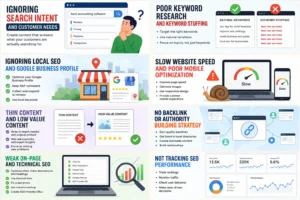
Ignoring Search Intent and Customer Needs
One of the biggest SEO mistakes small businesses make is creating content without understanding what users actually want.
Many business owners focus too much on keywords and forget the real purpose behind a search query. This is called search intent. Google tries to understand why someone is searching for something and then shows the most relevant results.
For example, someone searching for “best accounting software for small business” wants recommendations and comparisons. But if your page only talks about your company without answering the user’s question, Google may not rank your page well.
This problem hurts:
- search engine rankings
- user engagement
- conversion rates
- website traffic
Google wants pages that solve problems clearly and quickly.
Why Search Intent Matters for SEO
Modern SEO is built around user behavior. If visitors land on your page and leave quickly, Google sees it as a bad sign. This increases your bounce rate and reduces your chances of ranking higher.
There are different types of search intent:
- Informational intent
Users want information or answers. - Navigational intent
Users want to visit a specific website. - Transactional intent
Users are ready to buy or contact a business. - Commercial intent
Users are comparing products or services before making a decision.
Small businesses often create content that does not match these intents. This causes poor engagement and weak SEO performance.
Google’s AI systems, including AI Overviews, now prioritize content that directly answers questions in a simple and useful way.
Creating Content Users Actually Want
The best way to improve SEO is to create content around real customer questions.
Instead of writing random blog posts, focus on:
- customer pain points
- common industry questions
- local search queries
- buying intent
- service-related problems
For example, a local roofing company should create content like:
- “How to Fix a Roof Leak After Heavy Rain”
- “Best Roofing Materials for Hot Weather”
- “How Much Does Roof Repair Cost in Texas?”
These topics match real user needs and improve content relevance.
To better understand customer intent:
- Use Google autocomplete suggestions
- Check “People Also Ask” sections
- Review customer emails and FAQs
- Analyze competitor content
- Use tools like Google Search Console
The more helpful your content is, the stronger your SEO becomes.
Poor Keyword Research and Keyword Stuffing
Another common mistake small businesses make is targeting the wrong keywords or using too many keywords unnaturally.
Keyword research helps search engines understand what your content is about. But many businesses either skip research completely or focus on broad keywords that are too competitive.
Some businesses also repeat keywords too many times, thinking it will improve rankings. This is called keyword stuffing, and it can damage your SEO instead of helping it.
Google now understands context, entities, and semantic meaning much better than before. Modern SEO is about natural language and useful content, not repeating the same phrase again and again.
Targeting the Wrong Keywords
Many small businesses try to rank for broad keywords like:
- “SEO”
- “marketing”
- “website design”
These keywords are extremely competitive and difficult for small websites to rank for.
A smarter strategy is targeting long-tail keywords with clear intent.
For example:
- “local SEO services for dentists”
- “affordable website design for plumbers”
- “best SEO agency for small businesses”
These keywords may have lower search volume, but they usually bring better leads and conversions.
Good keyword research also helps improve:
- online visibility
- lead generation
- customer targeting
- SERP visibility
Small businesses should focus on keywords that match their services, audience, and location.
Why Keyword Stuffing Hurts Rankings
Keyword stuffing is one of the oldest SEO mistakes still hurting websites today.
Some pages repeat the same keyword so many times that the content becomes difficult to read. Google sees this as low-quality content.
For example:
“Small business SEO mistakes are common because small business SEO mistakes hurt small business SEO rankings.”
This sounds unnatural and provides no value to users.
Instead of forcing keywords everywhere, use natural variations and related terms.
Google now understands:
- synonyms
- related phrases
- user context
- semantic relationships
This is why using semantic SEO naturally is much more effective than stuffing keywords repeatedly.
Using Long-Tail and Local Keywords Naturally
Long-tail keywords are longer and more specific search phrases. They often bring highly targeted traffic.
Examples include:
- “best local SEO tips for restaurants”
- “how to improve Google rankings for small business”
- “SEO mistakes hurting local rankings”
Local keywords are also very important for small businesses.
Terms like:
- “near me”
- city names
- neighborhood names
- local services
help improve local search rankings and visibility in Google Maps.
When using keywords:
- place them naturally in headings
- include them in introductions
- use them in meta titles
- add them where relevant
- avoid over-optimization
Search engines now reward content that feels natural, useful, and easy to understand.
Ignoring Local SEO and Google Business Profile
Local SEO is one of the most powerful ways for small businesses to attract nearby customers. Yet many businesses either ignore it completely or only optimize it halfway.
If your business serves a local area, local SEO should be a top priority.
Without proper local optimization, your business may not appear in:
- Google Maps
- local pack results
- “near me” searches
- location-based searches
This is one of the biggest reasons many small businesses struggle to get consistent leads online.
Why Local SEO Is Important for Small Businesses
Almost half of all Google searches now have local intent. People search for nearby businesses every day.
Examples include:
- “best coffee shop near me”
- “emergency plumber in Chicago”
- “SEO agency in Dallas”
Google uses many local ranking factors, including:
- relevance
- distance
- trust signals
- reviews
- business information
Strong local SEO helps improve:
- website traffic
- phone calls
- local visibility
- walk-in customers
- conversion rates
For many small businesses, local SEO brings faster results than traditional SEO alone.
Common Google Business Profile Mistakes
Your Google Business Profile acts like a digital storefront. It helps Google understand your business and display it in local searches.
Many businesses make mistakes like:
- incomplete profiles
- wrong business categories
- missing business hours
- outdated phone numbers
- low-quality photos
- ignoring reviews
These problems reduce trust and hurt local rankings.
To optimize your profile:
- add accurate business information
- upload real business photos
- choose correct categories
- update working hours
- respond to reviews regularly
- publish updates and posts
Google prefers active and complete business profiles because they provide better user experience.
NAP Consistency, Reviews, and Local Citations
NAP stands for:
- Name
- Address
- Phone number
Your NAP information should stay consistent across all websites, directories, and social profiles.
If your business name or phone number changes across different platforms, Google may become confused about your business identity. This can hurt your local SEO performance.
Local citations from trusted directories also help improve authority.
Examples include:
- Yelp
- Bing Places
- Apple Maps
- industry directories
- local business listings
Reviews are another major ranking factor.
Positive reviews improve:
- trust
- local visibility
- customer confidence
- click-through rates
Businesses that actively manage reviews often perform better in local search results.
Slow Website Speed and Poor Mobile Optimization
Website speed and mobile usability are now major Google ranking factors. A slow or broken website creates a poor user experience and pushes visitors away.
Many small businesses spend money on content and marketing but ignore technical performance. This is a costly mistake because users expect websites to load quickly on all devices.
Today, most searches happen on mobile phones, not desktops. Google also uses mobile-first indexing, which means it mainly looks at the mobile version of your website when deciding rankings.
A slow website can hurt:
- organic traffic
- conversions
- user experience
- engagement
- search visibility
How Core Web Vitals Affect Rankings
Google uses Core Web Vitals to measure website performance and user experience.
The main Core Web Vitals include:
- Largest Contentful Paint (LCP)
Measures loading speed. - Interaction to Next Paint (INP)
Measures responsiveness. - Cumulative Layout Shift (CLS)
Measures visual stability.
If your website loads slowly or shifts while loading, users become frustrated and leave quickly.
This increases:
- bounce rate
- abandonment rate
- poor engagement signals
Google sees these as signs of weak user experience.
Tools like:
- Google PageSpeed Insights
- Google Search Console
can help identify performance issues.
Common Mobile SEO Problems
Many small business websites still have poor mobile experiences.
Common problems include:
- tiny text
- broken layouts
- buttons too close together
- slow-loading images
- popups blocking content
- difficult navigation
A website may look fine on desktop but completely fail on mobile devices.
Google prioritizes responsive websites that work smoothly across all screen sizes.
Businesses that ignore mobile optimization often lose rankings and customers to competitors with better mobile experiences.
Slow Website Speed and Poor Mobile Optimization
Improving Page Speed and User Experience
Improving website speed does not always require advanced coding. Small businesses can make major improvements by fixing a few common issues.
Start by:
- compressing large images
- removing unnecessary plugins
- enabling browser caching
- using reliable hosting
- minimizing heavy scripts
Fast websites improve:
- customer experience
- engagement
- conversions
- search engine rankings
A clean and responsive website also helps users trust your business.
Google wants websites that are:
- fast
- mobile-friendly
- easy to navigate
- visually stable
This is why technical performance is now directly connected to SEO success.
Weak On-Page and Technical SEO
Many small businesses create content but forget to properly optimize their pages for search engines.
On-page SEO and technical SEO help search engines:
- understand your content
- crawl your website
- index pages correctly
- improve rankings
Without proper optimization, even high-quality content may struggle to rank.
Weak technical SEO can also create:
- crawl errors
- indexing issues
- duplicate pages
- poor site structure
These problems reduce your website’s ability to compete in search results.
Optimizing Titles, Meta Descriptions, and Headings
Meta titles and headings help search engines understand your page topic.
A weak title can lower click-through rates, even if your page ranks well.
Good titles should:
- clearly describe the topic
- include target keywords naturally
- stay readable for humans
- encourage clicks
For example:
Bad title:
“Home | Services”
Better title:
“Affordable Local SEO Services for Small Businesses”
Meta descriptions are also important because they influence user clicks from search results.
Headings improve both readability and SEO structure.
Every page should use:
- one H1 heading
- clear H2 sections
- organized H3 subheadings
Proper heading structure improves:
- content organization
- user experience
- AI Overview extraction
- crawlability
Google’s AI systems prefer structured and easy-to-read content.
Internal Linking, Crawlability, and URL Structure
Internal links help users and search engines move through your website.
They also help distribute authority between pages.
Many small business websites either:
- use very few internal links
- or create confusing site structures
This hurts:
- indexing
- user navigation
- content discovery
- topical relevance
Good internal linking helps Google understand relationships between pages.
For example:
- blog posts should link to service pages
- service pages should link to related content
- related articles should connect naturally
URL structure also matters.
Bad URL:
example.com/page?id=123
Better URL:
example.com/local-seo-services
Simple URLs improve:
- readability
- trust
- SEO clarity
Search engines also prefer clean site architecture because it improves website optimization.
Schema Markup, Indexing, and Mobile-First Optimization
Schema markup helps search engines better understand your content.
Structured data can improve:
- rich snippets
- FAQs
- local business visibility
- review stars
- AI-generated search summaries
Small businesses should use:
- LocalBusiness schema
- FAQ schema
- Article schema
- Service schema
This helps Google connect your business with relevant searches.
Technical SEO also includes:
- fixing broken links
- submitting an XML sitemap
- improving HTTPS security
- checking crawl errors
Many businesses ignore these technical details, but they strongly affect search visibility.
Because Google uses mobile-first indexing, your mobile site should always work properly before anything else.
Publishing Thin or AI-Generated Content Without Value
Content quality is one of the biggest ranking factors today.
Google’s Helpful Content systems focus on content that:
- solves problems
- answers questions clearly
- provides real value
- shows expertise
Many small businesses now use AI tools to create content quickly. AI can help with ideas and drafts, but publishing low-quality AI content without editing can hurt rankings.
Google does not punish AI content automatically. It punishes low-quality content.
This includes:
- duplicate content
- keyword stuffing
- robotic writing
- inaccurate information
- generic paragraphs
Thin content often fails because it adds no unique value.
Why Google Prioritizes Helpful Content
Google wants users to find useful answers fast.
Helpful content usually:
- explains topics clearly
- uses real examples
- answers common questions
- includes expert insights
- solves real problems
Helpful pages improve:
- engagement
- trust
- time on page
- conversions
Low-value pages usually create:
- poor user experience
- weak rankings
- low authority
This is why modern SEO focuses heavily on content relevance and usefulness.
Common AI SEO Mistakes Small Businesses Make
Many businesses now depend too much on AI-generated writing.
Common mistakes include:
- publishing content without editing
- copying competitor content
- repeating the same phrases
- writing only for search engines
- ignoring user intent
Some AI-written articles sound unnatural because they use robotic phrases and filler text.
Google’s systems now understand:
- writing quality
- semantic relationships
- user behavior
- trust signals
Businesses should use AI as a helper, not a replacement for human expertise.
Strong content should include:
- real examples
- local insights
- customer problems
- practical solutions
- expert experience
This improves both SEO and user trust.
Adding E-E-A-T, Examples, and Expert Insights
Google uses E-E-A-T to evaluate content quality.
E-E-A-T stands for:
- Experience
- Expertise
- Authoritativeness
- Trustworthiness
Small businesses can improve E-E-A-T by:
- sharing real experiences
- adding case studies
- including expert advice
- showing real team information
- earning customer reviews
For example, a local contractor writing about roof repairs should explain:
- real project examples
- common customer problems
- repair methods
- local weather challenges
This creates stronger trust signals than generic content.
Adding expert insights also improves:
- website authority
- credibility
- engagement
- conversions
Google increasingly rewards content written by people with real-world knowledge.
No Backlink or Authority Building Strategy
Backlinks are still one of the strongest ranking signals in SEO.
A backlink happens when another website links to your content. Search engines treat these links as trust signals.
Many small businesses either:
- ignore backlinks completely
- or buy low-quality spam links
Both approaches hurt SEO growth.
Without backlinks, it becomes difficult to compete for higher rankings, especially in competitive industries.
Why Backlinks Still Matter for SEO
Backlinks help search engines understand:
- trust
- authority
- relevance
- popularity
Websites with strong backlinks often rank higher because search engines see them as more reliable.
Good backlinks can also:
- improve organic traffic
- increase brand awareness
- drive referral traffic
- improve domain authority
However, quality matters more than quantity.
A few trusted backlinks are usually better than hundreds of spam links.
Local Backlinks and Authority Signals
For small businesses, local backlinks are extremely valuable.
Examples include:
- local newspapers
- community websites
- local blogs
- chamber of commerce sites
- industry directories
These backlinks help improve:
- local SEO
- authority signals
- geographic relevance
Small businesses can earn backlinks by:
- sponsoring local events
- publishing useful guides
- collaborating with local organizations
- contributing guest articles
- sharing local case studies
This builds stronger trust with both users and search engines.
Common Link-Building Mistakes to Avoid
Many businesses damage their SEO by using outdated backlink tactics.
Common mistakes include:
- buying cheap backlinks
- using spam directories
- link exchanges
- irrelevant guest posts
- automated link-building tools
Google can detect unnatural links very easily.
Instead of chasing large numbers of backlinks, focus on:
- relevance
- quality
- authority
- trust
Natural backlinks from useful content are always the safest long-term strategy.
Not Tracking SEO Performance and Rankings
One of the biggest SEO mistakes is making changes without tracking results.
Many small businesses publish content and hope rankings improve automatically. But SEO requires regular monitoring and adjustments.
Tracking performance helps you understand:
- what is working
- what needs improvement
- which pages drive traffic
- where users leave your site
Without data, SEO becomes guesswork.
Using Google Search Console and GA4
Two of the most important SEO tools are:
- Google Search Console
- Google Analytics 4 (GA4)
Google Search Console helps track:
- keyword rankings
- indexing issues
- click-through rates
- impressions
- mobile usability problems
GA4 helps measure:
- traffic sources
- user behavior
- conversions
- engagement
- bounce rates
These tools help businesses make smarter SEO decisions.
Important SEO Metrics to Monitor
Small businesses should regularly monitor:
- organic traffic
- keyword rankings
- click-through rates
- conversion rates
- page speed
- bounce rate
- indexed pages
Tracking these metrics helps identify problems before rankings drop significantly.
SEO is not a one-time task. Search trends, algorithms, and user behavior change constantly.
Adapting Your SEO Strategy Over Time
Search engines continue to evolve every year.
Today, Google focuses heavily on:
- helpful content
- user experience
- semantic understanding
- AI-generated search results
- topical relevance
Businesses that continue using outdated SEO methods often lose rankings over time.
Successful businesses regularly:
- update old content
- improve technical SEO
- refresh keyword targeting
- optimize for AI search
- improve user experience
SEO works best when treated as a long-term growth strategy instead of a quick fix.
Small Business SEO Checklist
Use this checklist to avoid the most common SEO mistakes:
- Research keywords before creating content
- Focus on search intent
- Optimize your Google Business Profile
- Keep NAP information consistent
- Improve mobile usability
- Monitor Core Web Vitals
- Compress images for better page speed
- Add internal links between related pages
- Use proper heading structure
- Add schema markup
- Submit an XML sitemap
- Create helpful and original content
- Avoid keyword stuffing
- Build quality backlinks
- Track SEO performance using analytics tools
- Update old content regularly
Even small improvements can create major SEO growth over time.
Frequently Asked Questions
What are the most common SEO mistakes small businesses make?
The most common mistakes include ignoring local SEO, poor keyword research, weak content, slow website speed, and failing to optimize for mobile users. Many businesses also forget to track SEO performance or improve technical SEO issues.
Why is local SEO important for small businesses?
Local SEO helps businesses appear in Google Maps, local pack results, and “near me” searches. It improves visibility for nearby customers who are actively searching for local services or products.
Can AI-generated content hurt SEO rankings?
AI-generated content itself is not the problem. Low-quality or unhelpful content is the real issue. Businesses should always edit AI content, add expert insights, and focus on providing real value to users.
How long does SEO take for small businesses?
SEO usually takes several months before strong results appear. Factors like competition, website quality, backlinks, and content strategy all affect how quickly rankings improve.
How can small businesses improve Google rankings?
Small businesses can improve rankings by creating helpful content, optimizing local SEO, improving website speed, targeting the right keywords, and building strong backlinks. Consistent optimization is the key to long-term growth.
Conclusion
SEO can become one of the most powerful growth strategies for small businesses when done correctly. But many businesses continue making simple mistakes that hurt their rankings, traffic, and visibility.
From ignoring search intent to publishing thin content and neglecting technical SEO, these problems can stop your website from reaching its full potential.
The good news is that most SEO problems are fixable with the right strategy.
Focus on:
- user experience
- helpful content
- local SEO
- technical optimization
- authority building
- long-term consistency
Modern SEO is no longer about tricking search engines. It is about helping users find the best answers quickly and easily.
Businesses that create useful, trustworthy, and well-optimized content will continue growing in search results, even as AI search evolves.
If your business wants stronger search visibility, more organic traffic, and better online growth, focusing on smart SEO strategies can create lasting results. Companies like Meta Achievers understand how modern SEO, AI search optimization, and user-focused content work together to build sustainable rankings and real business growth.