But SEO has changed a lot.
Today, Google looks beyond rankings. Search engines now analyze user engagement, search intent, page experience, semantic relevance, and even how users interact with your content after clicking it. At the same time, AI-powered search platforms like ChatGPT, Gemini, Perplexity, and Google AI Overviews are changing how people discover information online.
That means modern SEO is no longer only about rankings and clicks. Businesses now need to track smarter SEO KPIs that show real business impact.
For example, imagine two websites:
- Website A gets 100,000 monthly visitors but almost no conversions.
- Website B gets only 15,000 visitors but generates qualified leads every day.
Which website has better SEO?
Obviously, Website B.
This is why tracking the right SEO performance indicators matters more than ever in 2026. Vanity traffic alone does not grow businesses anymore. Smart companies focus on visibility, engagement, conversions, trust, and revenue.
What Are SEO KPIs?
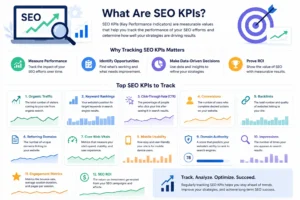
SEO KPIs are measurable values that help you track how well your SEO strategy is performing. These KPIs show whether your website is improving its search visibility, attracting qualified traffic, and generating business results from organic search.
In simple words, SEO KPIs help answer questions like:
- Are people finding your website on Google?
- Are users engaging with your content?
- Are visitors converting into leads or customers?
- Is your SEO strategy generating revenue?
Without proper KPI tracking, SEO becomes guesswork. You may spend months publishing content and building backlinks without understanding whether your efforts are actually helping the business grow.
That is why successful SEO campaigns always rely on data-driven decisions.
SEO KPIs vs SEO Metrics
Many people use the terms SEO metrics and KPIs interchangeably, but they are not exactly the same thing.
An SEO metric is simply a piece of data.
Examples include:
- clicks
- impressions
- bounce rate
- backlinks
- average session duration
These numbers help you understand website performance.
A KPI, however, is a metric directly connected to a business goal.
For example:
- organic conversion rate
- qualified leads
- SEO ROI
- customer acquisition cost
- revenue from organic traffic
Think about it this way:
Metrics provide information.
KPIs show whether your SEO strategy is helping your business grow.
This difference is important because many websites track hundreds of SEO metrics without focusing on the ones that actually matter.
Why SEO KPIs Matter More in 2026
SEO reporting has changed dramatically during the last few years.
Earlier, businesses mostly focused on:
- rankings
- traffic
- backlinks
But modern search engines now evaluate:
- content quality
- search intent satisfaction
- user experience
- engagement signals
- semantic relevance
- AI visibility
At the same time, search behavior is also changing.
Users now get answers directly from:
- Google AI Overviews
- featured snippets
- People Also Ask boxes
- ChatGPT
- Perplexity
This rise of zero-click searches means websites may lose clicks even when rankings stay strong.
That is why businesses now track more advanced SEO key performance indicators, including:
- engagement rate
- AI visibility
- search visibility
- conversion quality
- share of voice
- branded vs non-branded traffic
Modern SEO is becoming less about “ranking for keywords” and more about:
building authority, trust, visibility, and business impact.
Vanity Metrics vs Revenue-Driven SEO KPIs
One of the biggest SEO mistakes businesses make is focusing on vanity metrics.
Vanity metrics look impressive in reports but often provide little real business value.
Examples include:
- random impressions
- irrelevant traffic
- low-quality clicks
- ranking for unimportant keywords
A website can get thousands of visitors and still generate zero revenue.
That is why experienced SEO professionals focus more on revenue-driven KPIs.
These include:
- organic conversions
- lead quality
- SEO ROI
- customer lifetime value
- qualified demo requests
- revenue attribution
For example, many SaaS companies care more about:
- free trial signups
- booked demos
- pipeline growth
than total traffic.
Similarly, ecommerce stores focus more on:
- purchases
- revenue
- conversion rate
instead of vanity pageviews.
This shift is changing how businesses measure SEO success in 2026.
How to Choose the Right SEO KPIs
Not every business should track the same KPIs.
A local dental clinic, ecommerce store, SaaS company, and affiliate website all have different goals. That means their SEO reporting should also be different.
The smartest way to choose KPIs for SEO is to align them with business objectives.
Before tracking any metric, ask:
“How does this KPI help the business grow?”
If the answer is unclear, that KPI may not deserve much attention.
KPIs for Lead Generation Websites
Lead generation websites depend on turning visitors into inquiries or leads. Their SEO strategy should focus on attracting users with strong buying intent.
Important KPIs include:
- organic conversion rate
- form submissions
- booked calls
- qualified leads
- landing page engagement
- demo requests
For lead generation businesses, traffic quality matters more than traffic quantity.
A page attracting 500 highly targeted users can outperform another page bringing 20,000 untargeted visitors.
That is why successful lead generation SEO focuses heavily on:
- search intent
- conversion optimization
- audience targeting
- trust-building content
KPIs for SaaS SEO
SaaS SEO KPIs are different because SaaS businesses often depend on recurring revenue.
For SaaS companies, SEO is not just about generating traffic. It is about attracting users who eventually become paying customers.
Important SaaS SEO metrics include:
- free trial signups
- demo requests
- customer acquisition cost
- customer lifetime value
- MQLs (Marketing Qualified Leads)
- pipeline attribution
Strong SaaS SEO also focuses heavily on:
- educational content
- product-led content
- topical authority
- comparison pages
- solution-focused keywords
Many modern SaaS brands now measure how SEO contributes to long-term revenue instead of only measuring rankings.
KPIs for Ecommerce SEO
Ecommerce SEO focuses strongly on conversions and revenue generation.
For ecommerce websites, some of the most important organic search metrics include:
- product page traffic
- add-to-cart actions
- purchase conversions
- organic revenue
- average order value
- checkout completion rate
An ecommerce website with lower traffic but higher sales often performs better than a high-traffic website with weak conversion rates.
That is why ecommerce SEO strategies increasingly focus on:
- user experience
- product page optimization
- search intent alignment
- page speed
- mobile usability
These factors directly impact conversion performance.
KPIs for Local SEO
Local SEO works differently from traditional SEO because local businesses rely heavily on nearby customers.
For local businesses, visibility inside:
- Google Maps
- local packs
- Google Business Profile
is extremely important.
Key local SEO KPIs include:
- calls
- bookings
- direction requests
- local rankings
- reviews
- profile views
Review quality and consistency also play a huge role in local SEO performance.
Google prefers businesses with:
- recent reviews
- positive ratings
- accurate business information
- active profiles
This is why many local businesses now focus heavily on reputation management alongside traditional SEO.
The Most Important SEO KPIs to Track in 2026
Now that you understand how KPI selection works, let’s look at the most important SEO KPIs businesses should monitor in 2026.
These metrics provide a much clearer picture of real SEO performance than traditional rankings alone.
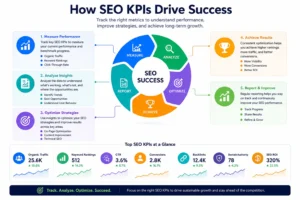
1. Organic Traffic & Engaged Sessions
Organic traffic measures how many visitors land on your website from unpaid search results.
This remains one of the most important SEO KPIs because it reflects your overall search visibility.
However, traffic alone is no longer enough.
Modern SEO also focuses on traffic quality.
That is why businesses increasingly track:
- engaged sessions
- returning visitors
- new users
- user behavior
- engagement signals
In GA4, an engaged session happens when:
- users stay longer than 10 seconds
- users visit multiple pages
- users complete important actions
This metric is much more useful than simple pageviews because it helps identify whether users actually find your content valuable.
For example:
If your traffic grows but engagement drops sharply, your content may not match user intent properly.
This is why modern SEO reporting now combines:
- organic traffic
- engagement rate
- user behavior metrics
instead of focusing only on visitor numbers.
2. Keyword Rankings & Search Visibility
Keyword rankings still matter because higher rankings improve visibility and traffic opportunities.
But modern SEO is no longer about tracking only a few exact-match keywords.
Search engines now understand:
- semantic relevance
- context
- search intent
- topical authority
This means one page can rank for hundreds of keyword variations naturally.
Instead of obsessing over single rankings, businesses now track broader search visibility metrics such as:
- impressions
- SERP features
- featured snippets
- People Also Ask visibility
- share of voice
For example:
A page ranking #3 with a featured snippet may outperform a page ranking #1 without enhanced SERP visibility.
This shift is why many advanced SEO teams now focus more on visibility coverage instead of isolated rankings.
Tools like:
- Google Search Console
- Ahrefs
- Semrush
help monitor these important SEO KPI metrics more accurately.
3. Organic Click-Through Rate (CTR)
Getting impressions on Google is good, but impressions alone do not grow businesses. Users must actually click your result.
That is where click-through rate (CTR) becomes important.
Organic CTR measures the percentage of users who click your website after seeing it in search results.
The formula is simple:
CTR = \frac{Clicks}{Impressions} \times 100
If your page receives:
- 1,000 impressions
- 100 clicks
your CTR is 10%.
A strong CTR usually means:
- your title is attractive
- your meta description matches search intent
- users trust your content
- your page stands out in SERPs
But SEO has changed a lot because of AI-powered search.
Today, Google often shows:
- AI Overviews
- featured snippets
- knowledge panels
- instant answers
before organic listings.
This means even high-ranking pages may receive fewer clicks than before.
That is why modern SEO teams now track:
- SERP visibility
- AI Overview presence
- zero-click search behavior
- branded search demand
instead of relying only on rankings.
To improve CTR naturally:
- write clear titles
- focus on user intent
- avoid clickbait
- use emotional triggers carefully
- include numbers only when useful
Pages with strong CTR often gain better long-term engagement because users already know what to expect before clicking.
4. Organic Conversion Rate
Traffic means nothing if visitors never take action.
This is why organic conversion rate is one of the most important SEO KPIs to track in 2026.
A conversion happens when users complete a valuable action, such as:
- purchasing a product
- filling out a form
- booking a call
- requesting a demo
- subscribing to a newsletter
Your conversion rate measures how effectively SEO traffic turns into customers or leads.
A page with:
- lower traffic
- but stronger conversions
is usually far more valuable than a page generating massive untargeted traffic.
This is where many businesses fail.
They celebrate traffic growth while ignoring:
- lead quality
- customer intent
- revenue impact
Modern SEO focuses heavily on conversion-focused content.
Strong conversion-focused pages usually:
- answer user questions clearly
- build trust quickly
- match search intent
- reduce confusion
- guide users naturally
This is also where user experience becomes extremely important.
Slow pages, poor layouts, and weak content often destroy conversion rates even if rankings remain strong.
That is why advanced SEO strategies now combine:
- SEO
- CRO (Conversion Rate Optimization)
- UX optimization
- semantic SEO
into one complete growth strategy.
5. User Engagement Metrics
Google increasingly measures how users interact with content after clicking a page.
If users quickly leave your website, it may signal:
- weak content quality
- poor UX
- wrong search intent targeting
This is why user engagement metrics are now critical SEO performance indicators.
Engagement Rate
Engagement rate measures how actively users interact with your website.
In GA4, engagement usually means users:
- stay longer than 10 seconds
- visit multiple pages
- complete meaningful actions
A strong engagement rate often shows that:
- your content satisfies search intent
- users find your information valuable
- your page experience is good
Google increasingly rewards pages that keep users engaged naturally.
Average Engagement Time
This metric measures how long users actively interact with your page.
Longer engagement times usually indicate:
- useful content
- stronger readability
- better structure
- higher content quality
But context matters.
For example:
- Long engagement on a blog article is usually positive.
- Long engagement on a checkout page may indicate confusion.
That is why SEO analysis should always consider user intent.
Bounce Rate
Bounce rate measures how many users leave your site without taking another action.
For years, marketers treated bounce rate as a negative signal. But modern SEO is more nuanced.
A high bounce rate does not always mean failure.
For example:
A user may:
- read your article completely
- find the answer
- leave satisfied
without visiting another page.
In that case, the content still successfully solved the user’s problem.
This is why bounce rate should never be analyzed alone. It works best when combined with:
- engagement time
- scroll depth
- conversions
- search intent satisfaction
Scroll Depth
Scroll depth helps measure how much content users actually consume.
If most visitors leave before reaching the middle of the page, it may indicate:
- weak introductions
- poor formatting
- slow-loading sections
- content mismatch
Modern SEO writing focuses heavily on readability.
That is why strong content usually includes:
- medium-length paragraphs
- natural flow
- proper spacing
- useful headings
- easy readability
These small improvements often increase engagement significantly.
6. Backlink & Authority Metrics
Backlinks remain one of the strongest Google ranking signals.
But SEO in 2026 is no longer about collecting huge numbers of random backlinks.
Today, Google values:
- authority
- trust
- relevance
- topical alignment
much more than raw backlink quantity.
Important backlink metrics include:
- referring domains
- authority score
- link quality
- backlink relevance
- earned backlinks
- lost backlinks
One strong backlink from a trusted industry website can provide more SEO value than hundreds of low-quality links.
This is why modern link building focuses heavily on:
- digital PR
- thought leadership
- original research
- helpful content
- topical authority
instead of spammy link tactics.
Why Referring Domains Matter
Many beginners focus only on total backlink count.
But experienced SEO professionals care more about:
unique referring domains.
If 100 backlinks come from the same website, their value is usually limited.
However, backlinks from multiple trusted domains help strengthen:
- authority
- credibility
- EEAT signals
- topical trust
This is why high-quality content naturally attracts stronger links over time.
Link Quality Is More Important Than Quantity
Not all backlinks help SEO.
Low-quality links from spammy websites may:
- weaken trust
- trigger algorithmic issues
- create ranking instability
Google now evaluates:
- contextual relevance
- website authority
- topical alignment
- natural link patterns
before assigning value to backlinks.
That is why strong SEO campaigns prioritize quality over volume.
7. Technical SEO KPIs
Even great content can struggle if a website has technical problems.
Technical SEO helps search engines:
- crawl pages
- understand structure
- index content correctly
- improve user experience
This is why technical SEO KPIs remain extremely important.
Key technical metrics include:
- Core Web Vitals
- page speed
- mobile usability
- indexing health
- crawlability
- HTTPS security
Core Web Vitals
Core Web Vitals are Google’s official page experience metrics.
They measure:
- loading speed
- visual stability
- interactivity
The three main Core Web Vitals are:
- Largest Contentful Paint (LCP)
- Interaction to Next Paint (INP)
- Cumulative Layout Shift (CLS)
Fast websites usually:
- improve engagement
- reduce bounce rate
- increase conversions
- create better UX
This is why page speed optimization directly impacts SEO performance.
Mobile Usability
Most searches now happen on mobile devices.
Google also uses mobile-first indexing, which means:
Google primarily evaluates the mobile version of your website.
If your mobile experience is poor, rankings can suffer even if desktop performance is strong.
Good mobile usability includes:
- responsive design
- readable text
- fast loading
- easy navigation
- clickable elements with proper spacing
Modern SEO success depends heavily on mobile user experience.
Crawlability & Indexing
Search engines must first discover and index your content before rankings become possible.
Technical problems such as:
- broken internal links
- blocked pages
- duplicate content
- incorrect canonical tags
can prevent indexing.
This is why SEO teams regularly monitor:
- crawl errors
- indexing reports
- sitemap health
- robots.txt configuration
using tools like:
- Google Search Console
- Screaming Frog
- Semrush Site Audit
Technical SEO may feel less exciting than content marketing, but it plays a huge role in long-term organic growth.
8. Branded vs Non-Branded Traffic
One of the smartest ways to evaluate SEO KPIs is by separating:
- branded traffic
- non-branded traffic
Branded traffic comes from searches containing your company or product name.
For example:
- “Meta Achievers SEO services”
Non-branded traffic comes from broader searches like:
- “best SEO KPIs”
- “technical SEO KPIs”
- “SEO KPI dashboard”
Non-branded traffic is often more valuable because it helps attract new audiences who may not know your brand yet.
This traffic reflects your true SEO reach.
Growing non-branded traffic usually means:
- stronger topical authority
- better keyword coverage
- improved search visibility
- broader audience targeting
Modern SEO strategies focus heavily on expanding non-branded search reach because it creates sustainable organic growth over time.
9. AI Visibility & Answer Engine Metrics
SEO is changing faster than ever because of AI-powered search.
A few years ago, users mostly clicked traditional blue links on Google. Today, millions of people now search using:
- ChatGPT
- Google AI Overviews
- Gemini
- Perplexity
- voice assistants
These platforms often provide direct answers without sending users to websites.
This shift is creating a new type of SEO measurement.
Businesses now need to track:
- AI visibility
- AI citations
- answer engine mentions
- AI share of voice
- semantic authority
because traditional rankings alone no longer tell the full story.
What Is AI Visibility?
AI visibility measures how often your brand or website appears inside AI-generated answers.
For example:
- Google AI Overviews may cite your content.
- ChatGPT may reference your website.
- Perplexity may include your brand in generated answers.
These mentions increase:
- authority
- trust
- brand exposure
even when users do not click immediately.
Modern SEO is slowly evolving into:
- search visibility optimization
- answer engine optimization
- entity-based optimization
instead of pure keyword ranking.
This is one of the biggest changes happening in SEO right now.
Why Semantic SEO Matters More Than Ever
AI search engines understand topics differently from traditional search algorithms.
They analyze:
- context
- relationships
- entities
- topical depth
- semantic relevance
instead of relying only on exact-match keywords.
That is why successful SEO content now focuses heavily on:
- semantic keywords
- topical clusters
- entity optimization
- natural language coverage
- contextual relevance
For example:
An article about SEO KPIs should naturally include related concepts like:
- organic traffic
- search visibility
- click-through rate
- Core Web Vitals
- keyword rankings
- user engagement
- conversion rate
- SEO ROI
- SERP features
This helps search engines fully understand the topic.
Modern SEO is no longer about repeating the same keyword dozens of times.
It is about demonstrating:
- expertise
- topical authority
- contextual depth
through naturally connected information.
How Google NLP & Entity SEO Affect Rankings
Google increasingly uses Natural Language Processing (NLP) to understand content.
Its algorithms now identify:
- entities
- relationships
- context
- user intent
- semantic patterns
This is why strong SEO articles naturally include:
- synonyms
- related concepts
- semantically connected phrases
- problem-solving explanations
instead of robotic keyword repetition.
For example:
A weak SEO article may repeat:
“SEO KPIs” 50 times.
But a strong semantic article naturally includes:
- SEO metrics
- organic search performance
- search engine rankings
- SEO reporting
- organic conversions
- search impressions
- technical SEO
- engagement metrics
This creates a much stronger topical profile.
EEAT & Trust Signals in Modern SEO
Google now strongly prioritizes EEAT:
- Experience
- Expertise
- Authoritativeness
- Trustworthiness
This means websites must prove:
- real expertise
- useful insights
- trustworthy information
- strong user experience
instead of publishing thin AI-generated content.
Modern SEO content performs best when it:
- solves real problems
- explains concepts clearly
- demonstrates experience
- includes practical insights
- matches user intent properly
This is one reason many generic SEO articles fail to rank long-term.
They provide information, but not real value.
What High-Quality SEO Content Looks Like in 2026
Strong SEO content today usually has:
- easy readability
- conversational tone
- semantic depth
- strong structure
- useful examples
- practical explanations
- natural keyword usage
It avoids:
- keyword stuffing
- robotic wording
- overly complex language
- AI-generated fluff
Google increasingly rewards content that feels:
genuinely helpful.
This is exactly why many brands now invest heavily in:
- topical authority
- editorial quality
- original research
- expert-driven content
instead of publishing large volumes of generic articles.
At Meta Achievers, modern SEO strategies focus not only on rankings but also on:
- content quality
- user behavior
- semantic optimization
- AI search visibility
- conversion-focused SEO
because long-term growth now depends on all these factors together.
How to Build an SEO KPI Dashboard
Tracking SEO KPIs manually becomes difficult as websites grow.
That is why businesses now use SEO dashboards to monitor performance in one place.
A strong SEO dashboard helps businesses:
- track progress
- identify opportunities
- spot technical issues
- measure ROI
- improve decision-making
Good dashboards simplify complex SEO data into clear insights.
The Most Important SEO Data Sources
Modern SEO reporting usually combines data from:
- Google Analytics 4
- Google Search Console
- Ahrefs
- Semrush
- Looker Studio
- Screaming Frog
Each platform provides different insights.
For example:
- GA4 tracks user behavior and conversions.
- Search Console tracks impressions and CTR.
- Ahrefs and Semrush monitor backlinks and rankings.
Combining these tools creates a much clearer picture of SEO performance.
What Should an SEO Dashboard Include?
A good SEO KPI dashboard should focus on actionable insights instead of overwhelming users with hundreds of metrics.
Important dashboard sections usually include:
- organic traffic
- keyword visibility
- engagement rate
- organic conversion rate
- backlink growth
- technical SEO health
- AI visibility metrics
- branded vs non-branded traffic
Businesses should also compare:
- month-over-month growth
- year-over-year trends
- competitor visibility
to understand long-term SEO progress properly.
How Often Should You Track SEO KPIs?
Different KPIs should be tracked at different intervals.
For example:
- rankings may fluctuate daily
- conversions may require monthly analysis
- backlink growth often needs long-term tracking
Most businesses follow this structure:
- weekly monitoring for critical KPIs
- monthly reporting for strategy analysis
- quarterly SEO audits for deeper optimization
SEO is a long-term strategy.
Daily ranking fluctuations are normal and should not cause panic.
The smartest SEO teams focus on:
- long-term growth
- visibility trends
- conversion improvement
- content performance
instead of reacting emotionally to short-term changes.
Common SEO KPI Mistakes to Avoid
Many businesses still make major SEO reporting mistakes.
These mistakes often lead to:
- poor strategy decisions
- wasted budgets
- misleading reports
Understanding these problems can help businesses track SEO performance more effectively.
Focusing Only on Rankings
One of the biggest SEO mistakes is treating rankings as the only KPI.
A #1 ranking means very little if:
- users do not click
- visitors do not convert
- traffic quality is weak
Modern SEO success depends on:
- visibility
- engagement
- conversions
- authority
- business impact
not rankings alone.
Ignoring Search Intent
Some websites generate traffic but fail to satisfy users.
This usually happens when content targets keywords without understanding:
- user goals
- search intent
- audience expectations
Google increasingly rewards pages that solve problems effectively.
This is why successful SEO content focuses heavily on:
- usefulness
- clarity
- relevance
- intent satisfaction
instead of only keyword placement.
Tracking Too Many Metrics
Many SEO reports contain dozens of meaningless charts.
Too much data creates confusion.
The best SEO dashboards focus only on KPIs that influence:
- growth
- revenue
- visibility
- conversions
- strategic decisions
Simple reporting is often more powerful than overly complicated reports.
Ignoring AI Search Trends
AI search is changing SEO rapidly.
Businesses that ignore:
- AI Overviews
- answer engines
- semantic optimization
- entity SEO
may lose future visibility.
SEO is moving toward:
- topical authority
- conversational content
- entity-based optimization
- AI-friendly formatting
This trend will likely become even stronger in the coming years.
Final Thoughts
SEO in 2026 is no longer just about ranking for keywords.
Search engines now evaluate:
- user experience
- semantic relevance
- content quality
- engagement signals
- AI visibility
- trustworthiness
This is why businesses must track smarter SEO KPIs instead of relying on vanity metrics.
The most successful SEO strategies focus on:
- organic traffic
- search visibility
- organic conversions
- engagement rate
- Core Web Vitals
- keyword rankings
- AI visibility
- business impact
together.
Modern SEO success comes from understanding both:
- search engines
- human behavior
Websites that create:
- genuinely helpful content
- trustworthy information
- strong user experiences
- semantically rich pages
will continue growing even as AI search evolves.
The future of SEO belongs to brands that focus on value first.
Because in modern search, helping users better than competitors is the real ranking advantage.
Frequently Asked Questions
What are the most important SEO KPIs in 2026?
The most important SEO KPIs in 2026 include:
- organic traffic
- search visibility
- organic conversion rate
- engagement rate
- Core Web Vitals
- keyword rankings
- AI visibility
- branded vs non-branded traffic
These KPIs provide a complete picture of both SEO performance and business growth.
Why are keyword rankings alone not enough anymore?
Modern search results now include:
- AI Overviews
- featured snippets
- People Also Ask
- videos
- local packs
This means rankings alone do not guarantee clicks or conversions. Businesses now also track search visibility, engagement, and conversion quality to measure real SEO success.
How does AI search impact SEO KPIs?
AI-powered search platforms often provide answers directly inside search results. Because of this, businesses now track:
- AI citations
- answer engine visibility
- semantic relevance
- entity authority
instead of focusing only on traditional organic clicks.
Which SEO KPIs matter most for local businesses?
For local SEO, the most valuable KPIs include:
- calls
- bookings
- direction requests
- Google Business Profile views
- local rankings
- customer reviews
These metrics directly reflect local customer engagement and business growth.
What is the difference between SEO metrics and SEO KPIs?
SEO metrics are general data points like impressions or pageviews.
SEO KPIs are metrics connected directly to business goals, such as:
- conversions
- qualified leads
- revenue
- SEO ROI
KPIs help businesses measure actual growth instead of vanity performance.
How often should SEO KPIs be monitored?
Critical SEO KPIs should usually be checked weekly, while detailed SEO reports are commonly reviewed monthly.
Long-term SEO growth is best measured through consistent trend analysis instead of daily ranking fluctuations.